Most contractors start as sole proprietors without deciding to. You take a job, you get paid, and the business structure is whatever happens by default.
That works until something goes wrong. Then the difference between structures becomes very concrete, because it determines whether a claim against the business can reach your house, your truck, and your savings.
Structure also affects your taxes, your licensing application, your ability to hire, and how easily you can sell the business later.
This guide explains the practical differences. It is education rather than legal or tax advice — the right answer depends on your numbers and your state, and both an attorney and a CPA are worth their fees on this decision.
The four common structures
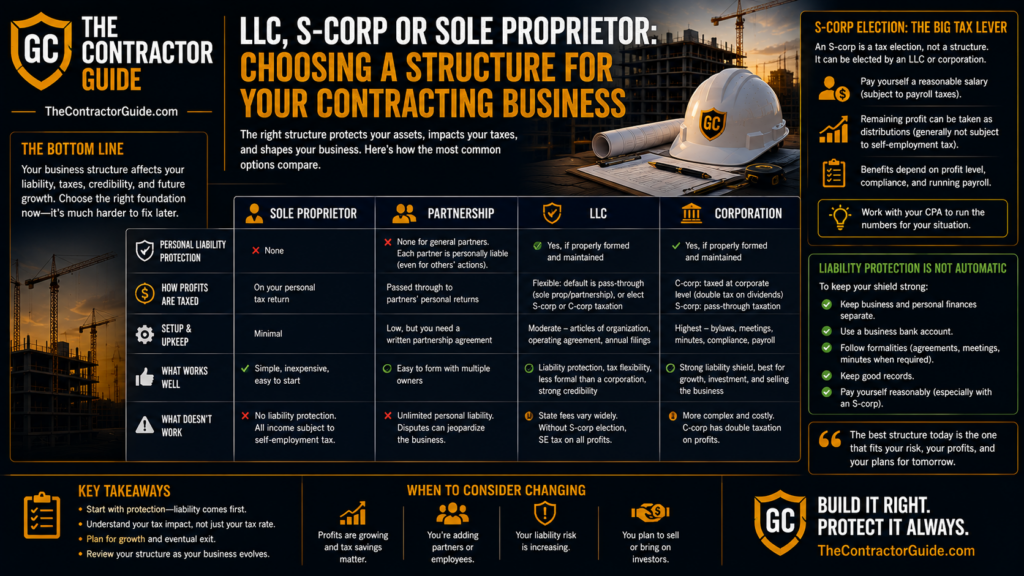
| Structure | Personal liability protection | How profits are taxed | Setup and upkeep |
| Sole proprietor | None | On your personal return | Minimal |
| Partnership | None for general partners | Passed to partners | Low, but needs an agreement |
| LLC | Yes, if maintained properly | Flexible — several options | Moderate |
| Corporation | Yes, if maintained properly | C-corp or S-corp election | Highest |
Two points clear up most of the confusion before we go further.
An S-corp is not a separate structure. It is a tax election. An LLC or a corporation can elect S-corp treatment. So “LLC or S-corp” is not really the question — the question is what entity to form, and then how it should be taxed.
Liability protection is not automatic. It depends on maintaining separation between you and the business. More on that below.
Sole proprietorship
You and the business are legally the same thing. No formation is required beyond any local business license and a fictitious name filing if you operate under a trade name.
What works. It is simple and cheap. Taxes go on your personal return. There is almost no ongoing administration.
What does not. There is no liability separation whatsoever. A judgment against the business is a judgment against you personally, reaching personal assets. You also pay self-employment tax on all net profit.
For contractors, the liability exposure is the problem. Construction generates injury and property damage claims, and insurance is your first line of defense — but a claim exceeding your limits reaches you directly.
Partnership
Two or more owners sharing a business without forming an entity. In a general partnership, each partner is personally liable — including for the other partner’s actions.
That last part deserves emphasis. Your partner can bind the business and create liability you are personally responsible for.
If you are going into business with someone, most advisors recommend forming an LLC or corporation rather than operating as a general partnership. Whatever structure you choose, put the agreement in writing before you start.
Limited liability company
The LLC is the most common choice for contractors, and for good reasons.
Liability protection. Properly formed and maintained, an LLC separates business obligations from personal assets.
Tax flexibility. A single-member LLC is taxed as a sole proprietorship by default. A multi-member LLC is taxed as a partnership by default. Either can elect corporate or S-corp treatment instead.
Manageable administration. Less formality than a corporation. Most states require articles of organization, an operating agreement, and an annual report or fee.
Credibility. Many customers and general contractors prefer working with an entity.
What to watch. Formation and annual fees vary considerably by state. Some states charge meaningfully more than others. And without an S-corp election, all net profit is generally subject to self-employment tax.
Corporation
A corporation is a separate legal entity owned by shareholders, run by officers and directors.
C-corporation treatment means the company pays tax on its profits and shareholders pay tax again on dividends. That double taxation makes it uncommon for small contractors, though it can suit businesses retaining significant earnings or seeking outside investment.
S-corporation treatment is an election that avoids double taxation by passing income through to shareholders. This is where the tax conversation usually lands.
Corporations carry the most formality — bylaws, a board, shareholder and director meetings, minutes, and stock records. That structure supports growth and outside investment, but it is real ongoing work.
The S-corp election and what it actually does
This is the part contractors ask about most, so here is the mechanism in plain terms.
As a sole proprietor or a default-taxed LLC, your entire net profit is generally subject to self-employment tax.
Under an S-corp election, you pay yourself a reasonable salary as an employee, subject to payroll taxes. Remaining profit can be distributed to you as a shareholder distribution, which is generally not subject to self-employment tax.
That difference is where the savings come from.
Three conditions determine whether it is worthwhile.
Profit level. The election adds payroll administration, tax preparation cost, and compliance work. Below a certain profit level, those costs exceed the savings. Your CPA can calculate the crossover point using your actual numbers.
Reasonable compensation. The salary must be genuinely reasonable for the work you perform. Paying yourself an artificially low salary to maximize distributions is a recognized audit issue.
Willingness to run payroll. You become an employee of your own company, with payroll filings, withholding, and quarterly obligations.
This is exactly the decision where a CPA earns their fee. The math is specific to your revenue, your profit, and what reasonable compensation looks like in your trade and market.
What liability protection actually requires
An LLC or corporation protects personal assets only if you maintain the separation. Courts can disregard the entity — commonly called piercing the corporate veil — when owners treat it as an extension of themselves.
To maintain protection:
Keep separate bank accounts. Never run personal expenses through the business account or vice versa.
Sign contracts in the entity’s name, with your title. Not personally.
Maintain required formalities. Annual reports, filings, and for corporations, meetings and minutes.
Capitalize the business adequately. Leave enough in it to operate.
Carry appropriate insurance. This matters more than most contractors expect, and it works alongside the entity rather than instead of it.
Do not commingle assets. The company truck belongs to the company.
That last point about insurance deserves elaboration. Business structure protects your personal assets from business obligations. It does not prevent claims, pay for damage, or defend you. Insurance does that work. A well-formed LLC with no liability coverage is still one serious claim away from losing the business itself.
How structure affects licensing
Your business structure and your contractor license are linked, and sequence matters.
Licenses are generally issued to a specific entity. If you form an LLC after getting licensed as a sole proprietor, you will usually need to apply for a new license or formally transfer it — which can mean new fees, a new bond, and processing time.
Decide your structure before applying for a license. Reversing the order costs time and money.
Bond and insurance requirements may also differ by structure, and some states require personal guarantees from owners regardless of entity type.
Practical guidance
There is no universally correct answer, but some patterns hold.
A sole proprietorship suits testing an idea or doing genuinely occasional small work. It is a starting point rather than a destination, and the liability exposure makes it poorly suited to sustained contracting.
An LLC fits the majority of working contractors. It provides liability separation with manageable administration and keeps tax options open.
An LLC with an S-corp election makes sense once profit reaches a level where self-employment tax savings exceed the added administration. Your CPA should run that calculation rather than a rule of thumb.
A corporation suits contractors planning significant growth, multiple owners, outside investment, or eventual sale.
You can also change structure later. It costs time and money and may require re-licensing, which is an argument for deciding deliberately at the start rather than defaulting.
Frequently asked questions
What is the best business structure for a contractor?
For most working contractors, an LLC balances liability protection against administrative burden while keeping tax options open. Sole proprietorships suit only occasional work because they offer no liability separation. Corporations suit contractors planning significant growth or outside investment.
Is an S-corp a type of business structure?
No. It is a tax election that an LLC or corporation can make. The structural decision is what entity to form; the S-corp question is how that entity should be taxed.
How does an S-corp election save money?
You pay yourself a reasonable salary subject to payroll taxes, and remaining profit can be distributed as shareholder distributions generally not subject to self-employment tax. The savings must exceed the added payroll and compliance costs, so it becomes worthwhile above a certain profit level.
Does an LLC protect me from lawsuits?
It protects personal assets from business obligations if you maintain separation — separate accounts, contracts signed in the entity’s name, required filings, adequate capitalization, and no commingling. It does not prevent claims or pay for damages. Insurance does that.
Do I need an LLC to get a contractor license?
No, but your license is issued to a specific entity. Decide your structure before applying, because forming an entity afterward typically requires a new license application or transfer, with new fees and processing time.
Can I change my business structure later?
Yes, though it involves formation costs, potential tax consequences, and often re-licensing. Deciding deliberately at the outset is considerably cheaper than converting later.
Do I still need insurance if I have an LLC?
Yes. Structure shields personal assets from business obligations. Insurance pays claims, funds legal defense, and satisfies licensing and contract requirements. They address different problems and you need both.
What happens if I go into business with a partner?
Without forming an entity, you are in a general partnership where each partner is personally liable, including for the other’s actions. Most advisors recommend forming an LLC or corporation and putting a written agreement in place before starting.
Decide it deliberately, and get help with the math
Business structure is one of the few decisions that touches liability, taxes, licensing, and eventual sale all at once. It is also one of the easiest to leave on autopilot, because doing nothing produces a sole proprietorship by default.
For most contractors the practical path is an LLC formed before applying for a license, with the S-corp election revisited once profit justifies it.
The tax portion genuinely warrants professional input. An hour with a CPA who works with contractors will tell you more about your specific situation than any general guide, and an attorney can confirm the formation is done properly for your state.
This article is general information, not legal or tax advice. Entity requirements, fees, and tax treatment vary by state and by individual circumstances. Consult an attorney and a CPA before deciding.