Most licensing states set a dollar figure below which you can perform work without a license. Small repairs fall under it. Real jobs do not.
That sounds simple, and it is where people get into trouble. The threshold is rarely just a number. It usually comes with conditions attached, and failing any one of them puts you back inside the licensing requirement — even on a very small job.
California’s rule illustrates this well, and its recent change shows why relying on outdated information is risky.
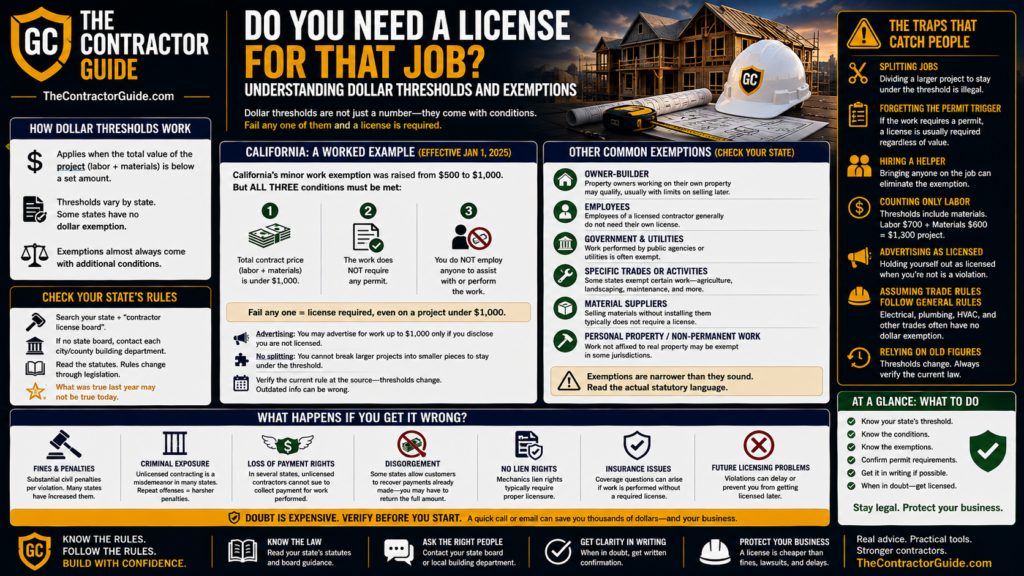
How dollar thresholds actually work
A licensing exemption for minor work typically applies when a project’s total value falls below a set amount. That value generally includes labor and materials combined, not just your labor.
Thresholds vary considerably by state, and many are low enough to capture nearly any paying job. Some states have no dollar exemption at all.
The critical detail is that most exemptions carry additional conditions. Meeting the dollar figure alone frequently is not enough.
California: a worked example
California raised its minor work exemption effective January 1, 2025, through Assembly Bill 2622. The threshold moved from $500 to $1,000.
But the state’s licensing board was explicit that the dollar figure is only part of the test. Under the current rule, the exemption applies only when all three of the following are true:
- The total contract price, including labor and materials, is under $1,000
- The work does not require a permit of any kind
- The unlicensed person does not employ anyone to assist with or perform the work
Fail any one and a license is required, even on a project well under $1,000.
The advertising rules follow the same logic. An unlicensed person may advertise for work up to the threshold only if the advertisement discloses that they are not licensed. And the exemption does not apply at all to anyone advertising that they are licensed or qualified to act as a contractor.
Two further points worth noting. The exemption cannot be manufactured — a larger project cannot be split into smaller pieces to stay under the line. And because this change is relatively recent, a great deal of published guidance still cites the old $500 figure.
That last point is the real lesson. Verify the current rule at the source, because thresholds change through legislation and secondhand information goes stale quickly.
Other common exemptions
Beyond dollar thresholds, most states recognize several categories of exempt work. The specifics vary, so treat these as things to check rather than rules to rely on.
Owner-builder. Property owners performing work on their own property often qualify, usually with limits on selling the property afterward. This exemption belongs to the owner, not to anyone they hire.
Employees. A person working as an employee of a licensed contractor generally does not need their own license.
Public utilities and government work. Certain work performed by utilities or public agencies falls outside licensing requirements.
Specific trades or activities. Many states exempt particular work — some agricultural construction, certain landscaping, or specified maintenance activities.
Material suppliers. Selling materials without installing them typically does not require a contractor license.
Personal property and non-permanent work. Some jurisdictions exempt work not affixed to real property.
Exemptions are narrower than they sound. Read the actual statutory language rather than a summary, including this one.
The traps that catch people
Splitting jobs. Dividing a larger project into several smaller contracts to stay under a threshold is a recognized violation, not a workaround.
Forgetting the permit trigger. In many states, work requiring a permit requires a license regardless of value. Permit requirements also vary by jurisdiction, so a job needing no permit in one city may need one nearby.
Hiring a helper. Bringing anyone onto the job can eliminate an exemption entirely, as California’s rule shows directly.
Counting only labor. Thresholds typically include materials. A $700 labor charge on a job with $600 in materials is a $1,300 project.
Advertising as licensed. Holding yourself out as a licensed contractor when you are not is generally a violation independent of any work performed, and it can void an exemption you would otherwise qualify for.
Assuming trade rules follow general rules. Electrical, plumbing, HVAC, and similar trades are frequently licensed separately, often with no dollar exemption at all.
Relying on old figures. Thresholds change. California’s moved recently, and published guidance still lags.
What happens if you get it wrong
Consequences vary by state, but the pattern is consistent and more severe than most people expect.
Fines and penalties. Many states impose substantial civil penalties per violation, and several have increased them recently.
Criminal exposure. Unlicensed contracting is a misdemeanor in a number of states, with escalating penalties for repeat offenses.
Loss of payment rights. This is the consequence that ends businesses. In several states, an unlicensed contractor cannot sue to collect payment for work performed. You do the job, the customer refuses to pay, and you have no legal recourse.
Disgorgement. Some states go further, allowing a customer to recover payments already made — meaning you can be ordered to return the full contract price even after completing the work satisfactorily.
No mechanics lien rights. Lien rights typically require proper licensure.
Insurance complications. Coverage questions can arise where an insured was performing work they were not licensed to perform.
Future licensing difficulty. A history of unlicensed work can complicate a later application.
Compared to any of that, licensing is inexpensive.
How to check your specific situation
Work through these questions before taking a job you are unsure about.
What is the total project value, including materials? Not just your labor.
Does the work require a permit? Check with the local building department, since requirements differ between jurisdictions.
Will anyone help you? Employees, helpers, or day labor can eliminate an exemption.
What trade is involved? Specialty trades often have separate rules and may have no exemption at all.
Where is the work located? Local licensing requirements exist even in states without a statewide license.
Is the exemption current? Verify with your state board rather than relying on published summaries.
When the answer is genuinely unclear, call your state licensing board. Boards answer these questions routinely, and a five-minute call is considerably cheaper than a penalty.
When to just get licensed
If you are regularly asking whether a job falls under a threshold, that itself is the answer.
Exemptions exist for genuinely minor work — a small repair, a modest one-person job. They are not a business model. A contractor building a real customer base will cross the line constantly, and the exposure compounds with every job.
Licensing also opens work that exemptions never reach: permitted projects, larger contracts, general contractor relationships, and customers who verify licensure before hiring.
The threshold is a floor for incidental work. It is not a tier of the industry you can operate in permanently.
Frequently asked questions
What is a minor work exemption?
It is a provision allowing unlicensed persons to perform small projects below a set dollar value. The value typically includes both labor and materials, and most states attach additional conditions beyond the dollar figure.
What is California’s contractor license threshold?
California’s minor work exemption is $1,000, raised from $500 effective January 1, 2025 under Assembly Bill 2622. The exemption applies only if the work requires no permit and the unlicensed person employs no one on the project. Failing either condition requires a license regardless of value.
Does the threshold include materials?
Generally yes. Most exemptions apply to the total contract price including labor, materials, and other costs — not to your labor charge alone.
Can I split a large job into smaller contracts to stay under the limit?
No. Dividing a project to remain below a threshold is a recognized violation rather than a legitimate strategy, and states treat it as unlicensed contracting.
Does needing a permit change whether I need a license?
Frequently yes. In many states, work requiring a permit requires a license regardless of project value. California’s rule states this directly. Permit requirements also vary by local jurisdiction.
Can I hire a helper on an exempt job?
Often not. California’s exemption is void if the unlicensed person employs anyone on the project, and other states apply similar restrictions. Check your state’s language before bringing anyone on.
What is an owner-builder exemption?
It allows property owners to perform work on their own property without a contractor license, typically with restrictions on selling the property afterward. The exemption belongs to the owner and does not extend to unlicensed people they hire.
What happens if I work without a required license?
Consequences can include civil penalties, misdemeanor charges, loss of the right to sue for payment, loss of mechanics lien rights, and in some states an obligation to return money already paid by the customer. The financial exposure typically exceeds the cost of licensing many times over.
Check the rule, not the rumor
Dollar thresholds sound like a simple line, and they are not. They come with permit conditions, employee conditions, advertising rules, and anti-splitting provisions. They also change — California’s moved recently, and plenty of guidance still cites the old number.
Before taking a job you are unsure about, work through the actual questions. Total value including materials. Permit requirement. Anyone helping. Which trade. Which jurisdiction. Then verify the current rule with your state board rather than trusting a summary.
And if the question keeps coming up, get licensed. Exemptions were written for incidental work, not for building a business.